DDS(Diretta Direct Stream) are network packets PURE filled with audio streams
it approaches Pure Audio






DDS(Diretta Direct Stream) are network packets PURE filled with audio streams
it approaches Pure Audio
Network audio is typically built on top of IP (Internet Protocol).
When utilizing Ethernet, arbitrary protocols are built on top of standardized protocols.
This imposes constraints on communication within the OS and Ethernet.
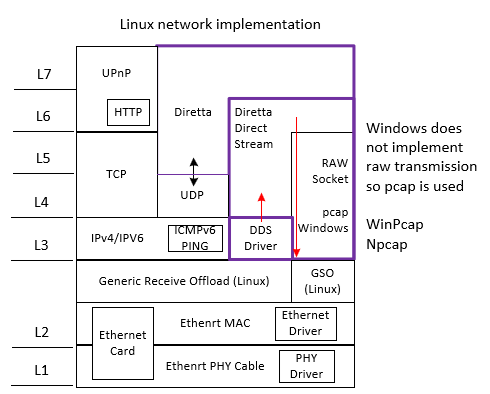
IP includes IPv4 and IPv6, with TCP and UDP existing on top of them.
Diretta utilizes IPv6/UDP, but many audio protocols use IPv4/TCP.
Some protocols claiming high sound quality utilize UDP.
The address length is 32 bits for IPv4 but 128 bits for IPv6, increasing the data volume.
However, there are several differences in their processing.
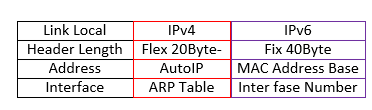
IPv4 requires consulting a transmission table to determine the Network Interface for communication,
and its variable-length header necessitates this determination.
Additionally, AutoIP issues cause address resolution delays at startup, requiring this process to run constantly.
Therefore, Diretta adopts IPv6.
TCP (Transmission Control Protocol) and UDP (User Datagram Protocol)
differ in whether flow control and packet loss handling are included within the protocol itself or handled by the user, as their names suggest.
Diretta handles all communication control, so UDP is used.
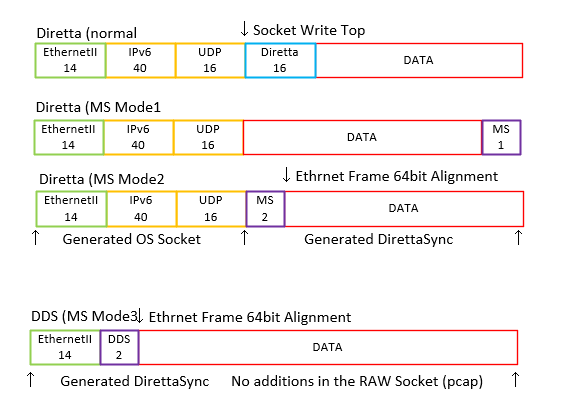
IPv6/UDP has a 48 byte header, and the Diretta Header is 16 bytes, resulting in a total header size of 64 bytes.
Through Diretta MSmode optimization, some functions of the Diretta Header/Footer are reassigned to the UDP Port Number, compressing the header to 1 or 2 bytes (49 or 50 bytes total).
This 1 byte difference exists to maintain memory alignment during transmission (MSmode1 or MSmode2) (MS stands for Multi Stream, but the name has no meaning).
UDP calculates a checksum, and similarly, the Ethernet Frame performs CRC calculation.
In the case of Link Local IPv6 addresses, they are generated from the MAC address, and the Ethernet Frame also contains a MAC Address.
Within Diretta, a protocol specialized for high-end audio, these parts were deemed redundant and optimizable.
DDS eliminates these redundant parts by creating a new protocol to replace IP, processing Ethernet frames directly into Direat within Diretta.
This reduces the header to 2 bytes. (These 2 bytes represent minimal control.)
Adding 2 bytes to the 14 byte Ethernet Frame II header places the audio data at a 64 bit alignment position, optimizing subsequent processing for the CPU architecture.
Resolves the redundant processing issues of using UDP (Internet Protocol) as Link Local.
Replacing IP with DDS fundamentally resolves the advantages and disadvantages of IPv4/IPv6.
IPv6/UDP continues to be used for connection authentication and other purposes, leveraging the benefits of connectivity.
https://help.diretta.link/en/support/solutions/articles/73000661171-dds-diretta-direct-stream
https://help.diretta.link/en/support/solutions/articles/73000661777-ms-mode-dds
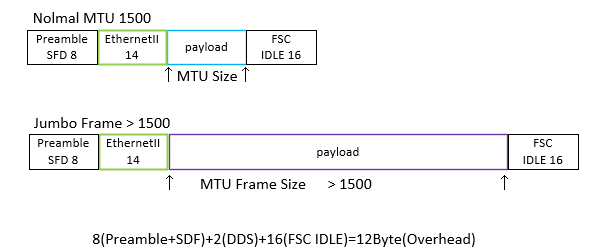
Ethernet communicates using packets.
An Ethernet Frame has a header and a trailer; the size excluding these is referred to as the MTU.
The sum of these sizes and the Ethernet II header and DDS header totals 12 bytes, which is the current minimum overhead.
Diretta mitigated this overhead even before DDS implementation by using a smaller header for its own MS Mode.
Standard Ethernet has an MTU of 1500 bytes. Increasing this size to reduce overhead is what Jumbo Frames achieve.
(Jumbo Frames are unrelated to DDS)
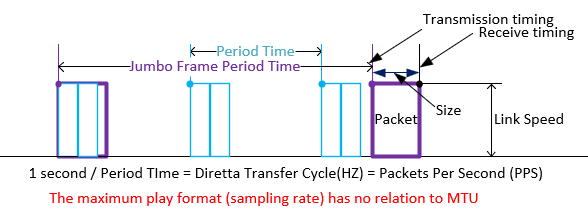
Diretta's audio stream transmission is managed by the transmission Period Time.
The transmission interval for packet transmission can be fixed or variable (with packet size changed or fixed) to adjust the transmission rate.
Increasing the Period Time allows larger sizes to be sent at once, and in some cases, multiple packets are sent simultaneously.
This inherently contradicts Diretta's concept of averaging processing, but overhead exists per packet, and interrupts during receive/transmit processing also increase.
These are trade-offs where audio quality preferences significantly influence the outcome, and control is left to manufacturers and users.
Jumbo Frame optimizes this process and becomes particularly advantageous when the Period Time is set long.
This seems to contradict the Diretta concept.
However, during high-rate playback, the standard MTU was too small, necessitating the transmission of multiple packets at once.
This issue can be optimized and resolved.
The MAX profile, which simply optimizes processing, uses the MTU as much as possible, extends the Period Time, and reduces the PPS.
(The maximum play format (sampling rate) has no relation to MTU)
(The embedded Ethernet does not support large Jumbo Frames)